How to Journal Your Recovery Without It Feeling Like a Chore
Journaling can genuinely help during porn recovery, but only if it doesn't turn into another obligation. Here's a lighter way to do it.

Journaling gets recommended constantly in recovery spaces, and for good reason — but a lot of people try it once, write two paragraphs of forced reflection, and never open the notebook again. It doesn't have to feel like homework to actually help.
Why journaling helps in the first place
The value of journaling in recovery isn't the writing itself — it's that it slows down the gap between an urge or a slip and your reaction to it. Writing a sentence about what happened forces a few seconds of actual thought before the next automatic response (shame, avoidance, doom-scrolling to distract). Over time, that pause is where you start noticing your own patterns: which times of day, which moods, which situations tend to precede an urge.
Why the "full reflection" format fails most people
A lot of journaling advice assumes you'll write several paragraphs of thoughtful reflection every day. For most people, that's an unrealistic standard to sustain, and missing a day of "proper" journaling often means the whole habit quietly dies. If writing three sentences is realistic and writing three paragraphs isn't, three sentences is the right amount — not a lesser version of the "real" thing.
A lighter format that's easier to keep
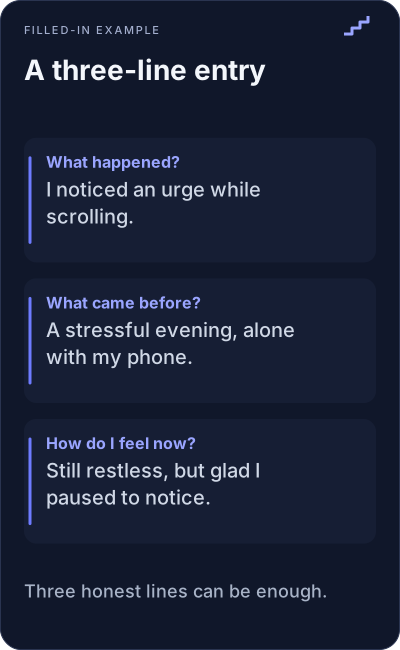
Instead of open-ended reflection, try a short structure you can fill in fast: what happened (urge, slip, or a clean day), what was going on right before it (bored, stressed, alone, late at night), and one honest sentence about how you feel about it now. That's it. Some days it's three lines. Some days you'll want to write more, and that's fine too — but the minimum bar stays low enough that skipping isn't tempting.
Logging slips without spiraling
The hardest entries to write are the ones after a slip, because the instinct is either to skip logging it entirely (avoidance) or to write a long self-critical entry (shame spiral). Neither helps. The useful version is closer to a lab notebook: what happened, what led up to it, logged plainly, without a verdict attached. The goal is information you can actually use next time, not a confession.
Where to keep it
Privacy matters here more than almost anywhere else — if you're worried about someone finding a notebook or an app, that worry alone will make you write less honestly, or stop writing at all. A private, on-device log (not shared, not backed up somewhere you don't control) tends to produce more honest entries than anything that feels even slightly exposed.
It's a tool, not a performance
The point of journaling during recovery isn't to produce something impressive or therapeutic-sounding. It's to give yourself, over weeks, a real record of your own patterns — the kind of pattern-spotting that's almost impossible to do from memory alone. Kept short and kept honest, it's one of the more useful habits you can build alongside everything else you're working on.
Available on the App Store.
A structured plan to reduce or quit porn —
without shame, surveillance, or religion. Start your first cycle today.