What Is a PMO Reboot? (And Does It Actually Work)
What a PMO reboot is, where the 90-day idea comes from, and what's realistic to expect from taking a break — without the hype or the shame.

If you've spent any time in recovery communities, you've seen the term "reboot" — usually attached to PMO (porn, masturbation, orgasm) and a specific number of days. It sounds almost technical, like a hardware fix. It's worth understanding what the term actually claims, and what's realistic to expect.
Where the term comes from
"Reboot" originated in online NoFap-adjacent communities as a way to describe a period of abstaining from porn (and often masturbation) with the goal of resetting sensitivity, motivation, and — in some framings — resolving porn-induced difficulties with arousal or attraction to real partners. The metaphor is a computer reboot: clear the cache, restart clean.
What the evidence actually supports
The clearest, best-supported effect of a period without porn is behavioral: time away from a habit reliably makes urges to return to it stronger at first, then gradually weaker as new routines take hold — that's ordinary habit science, not something specific to porn. Some people also report subjective improvements in mood, motivation, or how present they feel in their day-to-day life during a break, though this varies a lot person to person and isn't something research has firmly quantified.
The stronger claims — that a fixed number of days "resets" brain chemistry or fixes arousal issues — go beyond what current research can confidently support. Some people do report meaningful improvements after a period of abstinence; the honest answer is that the mechanism and reliability of this aren't settled science yet, whatever a specific forum thread's day-count might imply.
Why the day-count obsession can backfire
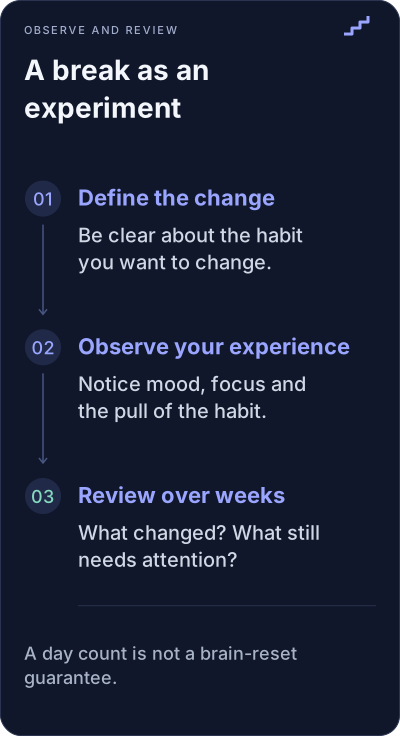
A lot of reboot culture centers on a target number — 30, 60, 90 days — treated almost like a threshold you cross into "fixed." This creates two problems. First, it turns a single slip into what feels like starting over from absolute zero, which is exactly the all-or-nothing framing that tends to make people give up entirely rather than get back on track quickly. Second, it sets up an expectation that day 91 will feel meaningfully different than day 89 — and when it doesn't, the whole effort can feel like it failed, even if real progress happened.
A more useful way to think about it
Instead of chasing a specific day count as a fix-it deadline, it's more sustainable to treat a break as an experiment: how does your mood, focus, or relationship with the habit change over weeks, independent of hitting an exact number? Progress that compounds — fewer urges, easier to redirect attention, less time spent thinking about it — tends to matter more than whether you technically reached day 90 without a single slip.
The honest takeaway
A reboot isn't magic, and it isn't nothing either. Time away from a compulsive habit genuinely does change how strong the pull feels, for most people, given enough weeks. What it isn't is a guaranteed reset with a fixed deadline — and treating it that way is often what turns a reasonable, gradual process into an all-or-nothing test you can fail.

Available on the App Store.
A structured plan to reduce or quit porn —
without shame, surveillance, or religion. Start your first cycle today.