Why You Keep Relapsing at the Same Time of Day (And What to Do About It)
Notice your slips keep happening around the same time of day? That's not a coincidence — here's why, and what to do to break the pattern.

Look back at your last several slips honestly, and there's a decent chance they cluster around a specific window — late at night, right after work, during a particular lull in the afternoon. That's not bad luck. Habits are strongly tied to time and context, and once you see the pattern, it becomes something you can actually plan around.
Why habits attach to specific times
Habits form through repeated pairing between a context and a behavior — and time of day is one of the strongest contexts there is, because it comes packaged with a whole set of related cues: being alone, being tired, being done with obligations for the day, having unstructured time. Late evening is a common trigger window for exactly this reason — it's often the first unstructured, private, low-energy stretch of the day, which happens to be exactly the conditions the habit originally formed under.
Why "just have more willpower at that time" doesn't fix it
Knowing the danger window intellectually doesn't neutralize it, because habit-driven behavior runs largely on autopilot, faster than deliberate decision-making. By the time you consciously notice "it's 11pm, this is my time," the automatic sequence is often already partway underway. Fighting it purely through willpower, at the exact moment your willpower is also depleted from a full day, is a hard match to win consistently.
Map your actual pattern first
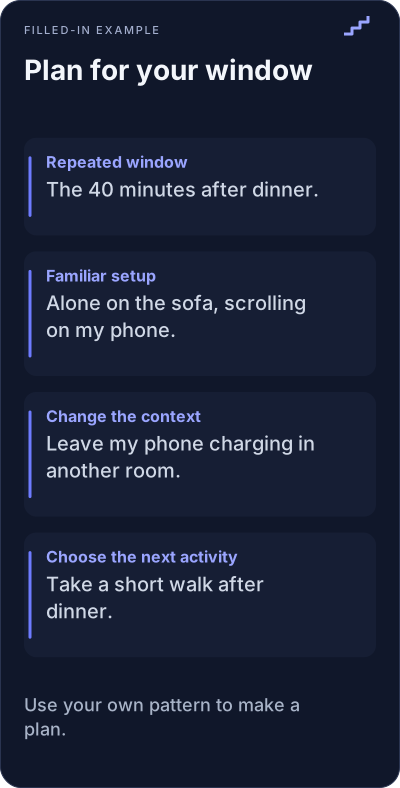
Before changing anything, spend a week or two just noting the time of day for urges and slips, without trying to fix it yet — the goal is an honest map, not a fast solution. Most people find the pattern is narrower than they expected: not "any time I'm alone," but something more specific, like "the 40 minutes after finishing dinner" or "right when I get into bed before falling asleep."
Change the context, not just the willpower
Once you know the window, the most effective interventions usually change something about the context itself, rather than asking for more discipline inside the same context. If it's late-night and alone in a specific room, that might mean changing where you spend that hour, having something specific already planned for it, or physically leaving your phone in another room during that window — removing the setup the habit relies on, rather than trying to out-willpower it every single night.
Replace the slot, don't just remove it
An empty, suddenly-habit-free time slot doesn't stay empty on its own — something will fill it, and left undecided, the old habit is the most familiar option available. Deciding in advance what goes into that specific window (a short walk, a call with someone, a show you actually enjoy) gives the time slot a new default, rather than leaving a vacuum the old pattern is well-positioned to fill.
The pattern is information, not a life sentence
A time-of-day pattern isn't proof that you're doomed to slip at 11pm forever — it's a specific, fixable weak point once you can see it clearly. Most people who map their pattern honestly find it's more specific and more addressable than the vague, all-day vulnerability it felt like before they looked closely.

Available on the App Store.
A structured plan to reduce or quit porn —
without shame, surveillance, or religion. Start your first cycle today.