How Long Does It Take to Quit Porn? A Realistic Timeline
How long does it actually take to quit porn? A realistic, non-hype timeline of what changes early on, at a few months, and long-term — no 30-day promises.

Search this question and you'll find a lot of confident answers — "90 days rewires your brain," "30 days and you're free." Those numbers get repeated because they're catchy, not because they're well established. Here's a more honest, less hyped-up look at what actually tends to change and when.
Why there's no single number
Quitting or reducing porn isn't like a wound healing on a fixed schedule — it depends on frequency and duration of the habit beforehand, what's driving it (boredom, stress, routine, something else), and what you're replacing it with. Two people starting the same week can be in very different places three months later. Anyone giving you an exact day count is selling certainty that doesn't really exist.
What tends to happen early on (first 1-2 weeks)
This is usually the hardest stretch — old cues (certain times of day, certain apps, boredom) are still fully wired, and the new pattern hasn't had time to form. Slips are common here and don't mean the approach isn't working; they mean the old habit is still strong, which is expected. This is where a gradual reduction approach tends to hold up better than an all-or-nothing cutoff, because it doesn't turn every early slip into "starting over from zero."
The 4-8 week stretch
For a lot of people, this is where specific triggers start becoming genuinely predictable — you notice "it's always late at night" or "it's always right after an argument." That's not a coincidence; it's the point where enough data has built up to actually see the pattern (see porn triggers for how to map yours). Urges in this window are often still strong but shorter-lived than at the start.
The few-months mark
By this point, many people report the behavior has stopped feeling automatic — it takes a genuine decision to act on an urge rather than it just happening on autopilot. That shift (automatic → decision point) is a more meaningful milestone than any specific day count, and it's roughly the timeframe where the popular "90 days" framing likely comes from, even though the real range varies a lot person to person.
Long-term (6+ months and beyond)
Triggers don't usually disappear completely — they show up less often and carry less pull. Setbacks can still happen occasionally, especially during high-stress periods, and that's normal rather than a sign of failure; see what to do after a relapse for how to handle it without spiraling.
The timeline that actually matters more than days
Tracking trend, not day-count, is a better way to judge progress: are slips getting less frequent over weeks? Are trigger-mode urges getting shorter? That's a far more useful signal than "is it day 47 or day 90 yet," and it's less likely to turn a single bad day into a perceived total reset.
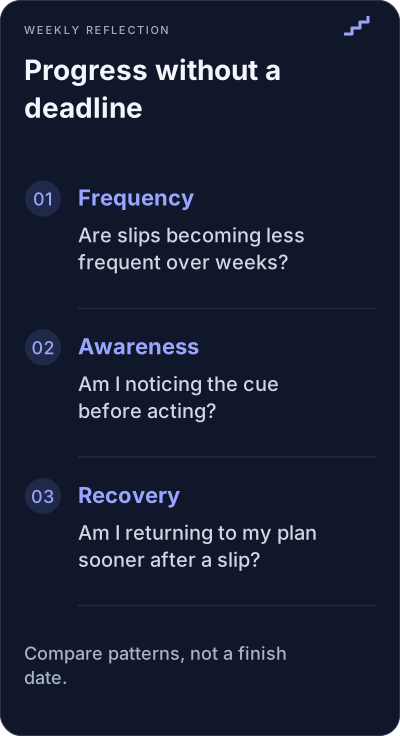
Built around gradual, trackable progress
Reset Ladder is built on step-based gradual reduction rather than a single all-or-nothing countdown — so progress is measured in trend and pattern, not a fragile streak that resets to zero on one slip.
This article is general information, not medical or psychological advice. If this behavior is causing you significant distress, consider speaking with a licensed mental health professional.
FAQ
Is the "90 days rewires your brain" claim true? It's a popular simplification without strong direct evidence behind the exact number. Real change happens gradually and varies by person — treat 90 days as a rough milestone, not a guarantee.
Is it normal to still have urges after months of progress? Yes. Urges typically become less frequent and less intense over time, but occasional urges — especially under stress — are a normal part of the process, not a sign it isn't working.
What matters more than the exact timeline? The trend: fewer slips, shorter urges, and faster recovery after a setback are better indicators of progress than counting days toward an arbitrary number.

Available on the App Store.
A structured plan to reduce or quit porn —
without shame, surveillance, or religion. Start your first cycle today.