What Triggers the Urge to Watch Porn? 7 Patterns to Notice Early
Porn urges rarely come out of nowhere. Learn 7 common triggers like stress, boredom, loneliness, and late-night scrolling, and how to notice them earlier.

Most urges do not come out of nowhere.
They feel sudden, but they usually aren’t.
By the time the urge becomes obvious, something has already started. A mood. A routine. A kind of emptiness. A familiar environment. A sequence your brain has walked through enough times that it now feels automatic.
That matters, because if you only pay attention to the last moment, you keep meeting the problem too late.
A lot of people try to quit porn by focusing on the final decision. The click. The search. The relapse. But the real leverage point is often earlier than that. It’s in the build-up. The drift. The pattern that quietly makes the urge stronger before you even call it an urge.
If you want more control, you need to get better at noticing what tends to come first.
Not every trigger looks dramatic. In fact, most of them are boring. That is part of what makes them dangerous.
What a trigger really is
A trigger is not just “something sexual.”
It is anything that reliably nudges you toward the same behavior.
Sometimes that’s obvious, like a suggestive image or explicit content. But more often it’s less direct than that. It can be an emotional state, a time of day, a place, a screen, a habit loop, or even a kind of tiredness.
A trigger does not force you to do anything. It just moves you closer to autopilot.
This is not a metaphor. A 2022 meta-analysis published in JAMA Psychiatry found that cue-induced craving more than tripled the odds of relapse across multiple types of compulsive behavior. In other words, the cues themselves — not just the desire — are a measurable predictor of what happens next. The brain learns to associate specific situations, moods, and environments with the behavior, and once those associations are formed, encountering the cue is enough to start the chain.
And the more often that sequence repeats, the less conscious it becomes.
That is why so many people say things like:
- “I didn’t even think about it”
- “It just happened”
- “I don’t know why I did it again”
Usually they do know, at least partly. They just haven’t slowed the pattern down enough to see it.
Read also: How to Stop Watching Porn When Willpower Keeps Failing
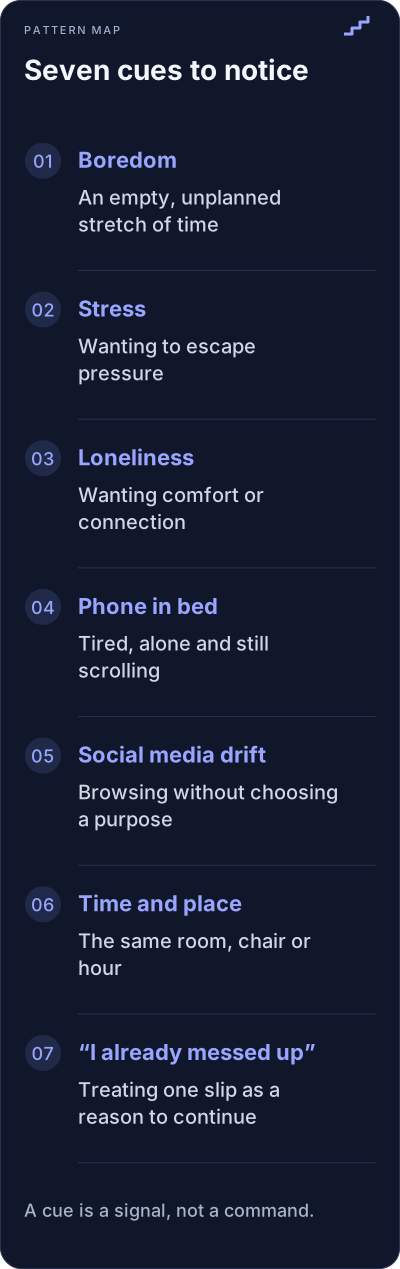
1. Boredom
Boredom is one of the most underestimated triggers.
People talk about stress all the time, but boredom can be just as powerful. Maybe more.
Because boredom creates space. And if your brain has learned that porn is a fast way to fill that space, then boredom becomes the beginning of a loop: nothing to do → restlessness → scrolling → stimulation → relapse
This is especially common when you’re:
- alone
- slightly tired
- not working
- not fully engaged in anything
- “just killing time”
The problem with boredom is that it feels harmless. You don’t take it seriously. But that low-grade restlessness is often exactly where the drift begins.
What helps
Do not wait until you feel deeply tempted. Pay attention when the evening starts feeling empty and unstructured.
The trigger is often not “I want porn.” The trigger is: “I have nothing that feels worth doing right now.”
That’s earlier. That’s usable.
2. Stress
Stress is one of the most common triggers because porn can become a quick way to shut your brain off.
Not solve anything. Not improve anything. Just interrupt the pressure for a moment.
That is why relapses often happen after:
- difficult work
- conflict
- overload
- uncertainty
- social pressure
- emotional exhaustion
Stress narrows your thinking. It makes short-term relief feel more convincing than long-term goals. Suddenly the part of you that cares about the future gets quieter, and the part that wants immediate escape gets louder.
This is not a character flaw. It’s a pattern of regulation.
What helps
Try asking a slightly different question.
Instead of: “Why do I want porn right now?”
ask: “What do I want relief from right now?”
That question is usually much more honest.
3. Loneliness
Loneliness is different from being alone.
Some people relapse constantly while living with others. Some do fine when they’re by themselves. So the issue isn’t just isolation. It’s the feeling of emotional disconnection.
Porn can become a substitute for intimacy, attention, comfort, stimulation, or just a temporary sense of not being empty.
That’s why loneliness is such a difficult trigger to handle. It doesn’t always feel urgent. Sometimes it just feels flat. Quiet. Numb. Like something is missing but you do not want to sit with the feeling long enough to name it.
So you reach for the familiar shortcut.
What helps
Notice the difference between:
- wanting stimulation
- wanting comfort
- wanting connection
- wanting escape
They can blur together, but they are not the same.
If you label loneliness accurately, you are already less trapped by it.
4. Late-night phone use
This one is so common it’s almost boring to mention, but boring patterns ruin plenty of lives.
A lot of relapses do not begin with an urge. They begin with a phone in bed.
You are tired. Your self-control is lower. The room is dark. Nobody is watching. You are not planning to relapse. You are just scrolling. Then your feed drifts. Then your attention narrows. Then curiosity wakes up. Then the loop starts.
At that point, the relapse often feels spontaneous. It wasn’t. It was just well set up. (There's a separate piece on why nights are the highest-risk window and what environment changes actually break the loop.)
What helps
Some of the most effective changes are painfully simple:
- don’t take the phone to bed
- charge it across the room
- shut the laptop before you start drifting
- leave the room when the scroll becomes aimless
These are not glamorous solutions. They work because they reduce exposure to the first easy step.
5. Social media drift
Social media is not the same as porn, but for a lot of people it is part of the runway.
Not because every platform is explicit, but because algorithmic feeds are excellent at moving you gradually toward stimulation. That movement can be so subtle that by the time you notice your state changing, you’ve already gone several steps deeper.
That is why many people do not start with a porn site at all. They start with:
- X
- YouTube shorts
- random image feeds
- “just browsing”
Then one thing leads to another.
What helps
Take “drift” seriously.
The danger is often not the first piece of content. It’s the loss of intentionality.
The moment you notice that you are no longer choosing what you’re looking at, you are already in the zone where triggers get stronger.
6. Habitual time-and-place cues
Sometimes the trigger is not emotional at all.
Sometimes it is just pattern memory.
Same room. Same chair. Same time. Same weekend rhythm. Same moment after work. Same hour after everyone else goes to sleep.
Your brain remembers context. If certain places and times were repeatedly connected to porn use, those cues can start activating the urge before any conscious desire is even there.
This is one reason people say:
- “I always struggle at night”
- “Sundays are the worst”
- “As soon as I’m alone at home, it starts”
- “The urge always shows up after work”
That is not random weakness. That is learned association.
What helps
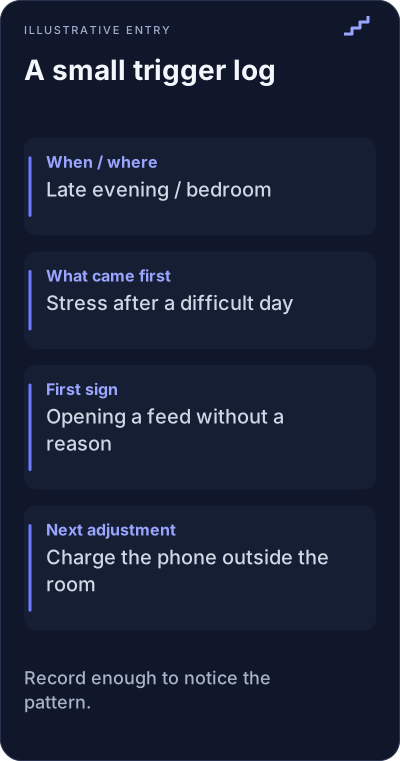
Do not just track what you did. Track:
- when
- where
- what had just happened
- what usually happens next in that environment
Even one week of honest notes can expose a pattern you’ve been living inside for months.
7. The “I already messed up” trigger
This one is more subtle, but it catches a lot of people.
The trigger is not the first mistake. The trigger is the thought that follows it.
Maybe you scrolled too long. Maybe you looked at something suggestive. Maybe you crossed a line you did not want to cross.
Then comes the thought: “Well, I already ruined it.”
That thought has probably fueled more binges than desire itself.
Because once you believe the day is already lost, the pressure to recover disappears. Shame takes over, and the relapse becomes easier to justify.
What helps
Interrupt that sentence early.
“I already slipped” does not mean:
- “I might as well keep going”
- “today is wasted”
- “I failed completely”
It just means:
- something happened
- the pattern is active
- now I need to respond clearly
That is a very different mindset. (The first hour after a slip is where most spirals form — there's a piece on what actually helps in those moments.)
The first two minutes matter more than people think
Most people imagine recovery as one big heroic moment of resistance.
In reality, a lot of it comes down to the first two minutes after a trigger becomes noticeable.
Those two minutes are where things either:
- tighten into the usual loop
- or loosen enough for you to interrupt them
That is why it helps to have a small response ready before you need it.
Not a perfect plan. Just something simple.
For example:
- put the phone down
- stand up
- go get water
- leave the room
- take ten breaths
- write down the trigger
- set a two-minute timer
- say out loud what is happening
You are not trying to feel strong. You are trying to stop the drift.
Why logging triggers helps so much
People often avoid tracking because they think it will make them obsessive.
Used badly, maybe. Used well, it does the opposite.
A short log helps you stop turning every relapse into mystery.
You begin to see things like:
- most slips happen after stress
- or after boredom
- or after scrolling
- or between 11 PM and 1 AM
- or when you feel lonely but tell yourself you are just tired
That kind of clarity changes how you respond.
You stop making random promises and start building around real patterns.
And once the patterns are visible, the whole thing becomes less magical and less powerful.
Still hard, but less foggy.
A trigger is not a command
This is worth remembering because a lot of people unconsciously act as if feeling the urge means the process is already over.
It isn’t.
A trigger is a nudge. A pattern. A learned path.
It is not a final decision.
The earlier you notice it, the weaker it is.
That is why awareness matters so much here. Not because awareness alone solves the problem, but because it gives you a chance to act before the familiar loop fully takes over.
That chance is often small. But it is real.
What to do today
Start simple.
Write down:
- your three most common triggers
- what time they usually show up
- what environment they happen in
- the first sign that the pattern is starting
- one action that helps you interrupt it
Do not overcomplicate it. Do not build a giant life system in one evening.
Just get more honest about what keeps happening before the urge gets strong.
That alone will make the next step clearer.
FAQ
Are triggers always sexual?
No. Many of the strongest triggers are emotional or situational: boredom, stress, loneliness, scrolling, time of day, or being in a familiar environment.
What if I know my triggers but still relapse?
That is still progress. Awareness is not the final step, but it is the beginning of better control. Seeing the pattern earlier gives you a chance to interrupt it earlier.
Is boredom really that powerful?
Yes. For many people, boredom is one of the most common starting points because it creates restlessness and a need for stimulation.
Should I avoid all triggers completely?
Not always. Some triggers can be reduced through environment and routine changes. Others need better responses rather than complete avoidance.
If recognizing your triggers earlier is the next step, Reset Ladder is built to support exactly that — gradual cycles, slip logging with trigger tagging, and explicit recovery built in for when the pattern still wins. It is available on the App Store.
Available on the App Store.
A structured plan to reduce or quit porn —
without shame, surveillance, or religion. Start your first cycle today.