How to Stop Watching Porn When Willpower Keeps Failing
Trying to stop watching porn but keep falling into the same loop? Learn a practical, shame-free way to understand triggers, interrupt urges, and get back on track.

Most people who want to stop watching porn don’t have a motivation problem.
They have a pattern problem.
That matters, because those are two very different things.
If motivation were enough, you would have solved this already. You’ve probably had serious moments. Clear moments. Moments where you were tired of repeating the same cycle and genuinely wanted out. And maybe for a while, that worked. A few clean days. A better stretch. A little hope.
Then real life showed up again.
Stress. Boredom. Late-night scrolling. A bad mood. A lonely evening. A rough day. One small trigger. Then another. And suddenly you’re back in the same place, wondering why the version of you who was so determined a few days ago seems to vanish exactly when you need him most.
That’s the frustrating part. Not just the relapse itself, but how predictable the whole thing starts to feel.
And that’s exactly why willpower alone keeps failing.
Because willpower is unstable. It changes with sleep, stress, mood, environment, routine, loneliness, and how tired your brain is when the urge hits. Research on sleep and self-control consistently shows that fatigue impairs the prefrontal cortex's ability to override impulsive responses — meaning the version of yourself who has to make the hard decision at midnight is, neurologically, not the same version who planned the recovery this morning.
If your whole strategy depends on feeling strong at the right moment, it’s going to break at the exact moment you’re weakest.
So if you want to stop watching porn, the goal isn’t to become some flawless machine with infinite discipline.
The goal is to build a system that still helps you when discipline is low.
Why trying harder usually doesn’t work
A lot of advice around porn use is built on the idea that the solution is to become stricter, tougher, and more ashamed of your failures.
That sounds intense, but intensity is not the same thing as effectiveness.
Trying harder can work for a few days. Sometimes even a few weeks. But if nothing in the structure of the behavior changes, you usually end up back where you started.
Because most relapses do not happen when you are calm, rested, and thinking clearly.
They happen when your brain wants relief.
That relief might come from distraction. Numbing out. Escaping pressure. Escaping boredom. Escaping loneliness. Escaping yourself for a few minutes.
That’s why porn use is often less about sex than people admit. Sometimes it’s just a shortcut into a different mental state.
And if that’s what it has become, then quitting is not simply about “being more disciplined.” It’s about removing a learned escape route and replacing it with something more stable.
That is a deeper problem than motivation.
The relapse usually starts earlier than you think
Most people focus on the final moment.
The click. The search. The relapse.
But by the time you get there, a lot has already happened.
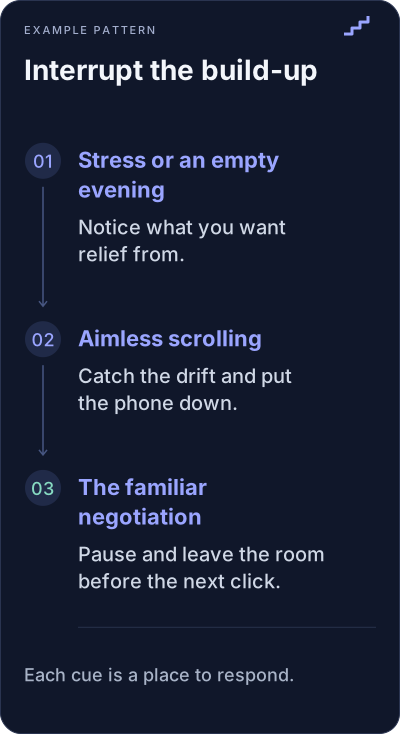
A relapse usually has a build-up.
Maybe it started with stress. Then mindless scrolling. Then one suggestive image. Then a little curiosity. Then the thought that you’ve already gone this far. Then the familiar internal negotiation. Then the thing you told yourself you wouldn’t do again.
Or maybe it started with something even simpler: an empty evening and no plan. (For most people, late nights are the highest-risk window for exactly this reason — multiple risk factors stack at the same time.)
That’s why treating the relapse as a random event is such a mistake. It usually isn’t random at all. It’s the last step in a sequence.
And if you only fight the last step, you’re always fighting late.
Real progress begins when you start noticing the earlier parts of the chain.
Not because awareness magically solves everything, but because it gives you a chance to interrupt the pattern before it gets heavy.
Shame feels useful, but usually makes things worse
One of the cruelest parts of this cycle is that shame can feel productive.
It makes things feel serious. It gives the illusion that because you feel awful, you must be changing.
But shame rarely helps people build stability.
What it usually builds is drama.
You relapse. You feel disgusted with yourself. You make extreme promises. You become rigid for a while. Then you crack again. Then the shame gets worse.
That cycle can go on for years.
And the worst part is that shame often turns one slip into several. Not because the first slip “proved” anything, but because once the spiral starts, people stop acting like someone recovering and start acting like someone who already believes he failed.
That mindset is poison.
A relapse is not a verdict. It is not proof that you are broken. It is not proof that change is fake.
A relapse is information.
That doesn’t mean it feels good. It means it can still be useful.
What actually helps more than self-hatred
The people who make progress usually stop treating the problem as a moral performance and start treating it as a system problem.
That shift changes everything.
Instead of asking, “Why am I like this?” they begin asking, “What keeps leading me here?”
Instead of trying to win a dramatic internal battle every night, they reduce the number of situations where that battle happens in the first place.
Instead of assuming they need perfect self-control, they build small responses that work even when they feel weak.
That is where real traction comes from.
1. Catch the pattern earlier
You do not need to become hyper-obsessed with every thought in your head.
But you do need to get more honest about what usually happens before the urge.
Maybe it’s:
- being alone late at night
- staying on your phone in bed
- stress after work
- boredom in the afternoon
- social media drift
- loneliness
- alcohol
- emotional numbness
- avoidance
Most people already know their triggers. They just don’t want to admit how repetitive they are.
If you can name them, you can plan for them. (A 2022 meta-analysis published in JAMA Psychiatry found that cue-induced craving more than tripled the odds of relapse — meaning the cues are not just background noise, they are a measurable predictor of what happens next. The same review covers the broader pattern of triggers in more depth.)
If you refuse to name them, you keep pretending the whole thing is unpredictable.
2. Make the first response simple
When the urge hits, you are not going to execute some elegant 12-step self-improvement protocol.
The first action needs to be simple enough to survive stress.
That might mean:
- putting the phone down
- standing up
- drinking water
- stepping out of the room
- taking ten slow breaths
- opening a note and writing down what triggered you
- setting a two-minute pause before doing anything else
This is not about pretending a glass of water cures compulsion. It doesn’t.
It’s about interrupting momentum.
That small interruption matters more than people think.
3. Track without turning it into punishment
If you never log anything, every relapse feels like chaos.
If you keep a simple record, patterns start becoming visible:
- what time it happens
- what mood came first
- whether you were alone
- what kind of trigger came before it
- how often it follows stress, boredom, or scrolling
- whether you recover quickly or spiral
You do not need to turn your life into a spreadsheet. You just need enough truth to stop repeating the same story in the dark.
4. Have a relapse plan before you need one
This is where a lot of people fail badly.
They have a plan for being clean, but no plan for what to do after they slip.
So when relapse happens, they improvise. And what most people improvise in that state is garbage. (The first hour after a slip is where most spirals start — there's a separate piece on what actually helps in the moments right after a relapse.)
A better response is boring and calm:
- log what happened
- identify the trigger
- note what led up to it
- remove the immediate friction point
- reset the cycle
- move on
No speech. No self-humiliation. No “well, the day is already ruined.”
That kind of recovery matters.
Progress is often quieter than people expect
A lot of people quit because they expect transformation to feel dramatic.
It usually doesn’t.
Sometimes progress looks like:
- fewer relapses
- shorter spirals
- less secrecy
- catching urges earlier
- less automatic behavior
- more awareness
- better recovery after a slip
- less shame after mistakes
That still counts.
If you used to lose whole weekends and now you recover within an hour, that matters.
If you used to act automatically and now you can name the trigger before the relapse happens, that matters.
If you used to binge after every slip and now you stop after one, that matters too.
Not every form of progress is glamorous. Most of it is structural.
And structural progress is what lasts.
You do not need perfect control. You need fewer blind spots.
That may be the most honest way to think about this.
You do not need to become a completely different person overnight.
You do not need to wake up tomorrow with no urges, no bad habits, no weak moments, and no emotional mess.
You need fewer moments where the pattern runs without you noticing it.
You need fewer situations where your environment is stronger than your intention.
You need a better response when you feel vulnerable.
You need a way to restart without turning one mistake into a collapse.
That is a much more realistic goal. And realistic goals are the only ones people can actually live with long enough to change.
A better question to ask yourself
Instead of asking:
“Why do I keep failing?”
try asking:
“What keeps happening before I fail?”
That question is less dramatic. It is also far more useful.
Because once you start seeing the pattern clearly, you stop depending so much on force.
And once you stop depending entirely on force, change becomes more stable.
Not easy. Not instant. But real.
Where to start today
If you want a practical starting point, keep it simple.
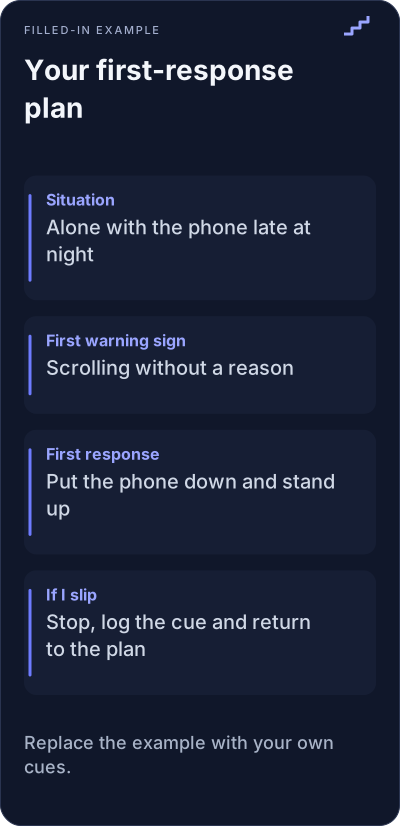
Write down:
- The three situations where you are most likely to relapse
- The first warning sign that usually comes before it
- One action that helps you interrupt the pattern early
- What you will do immediately after a slip instead of spiraling
That is already better than making another emotional promise and hoping this time your future self will magically behave differently.
He probably won’t.
But a better system might.
FAQ
Is it normal to relapse even if I genuinely want to stop?
Yes. Wanting change and having a working structure are not the same thing. Relapse usually means the system is weak, not that the desire is fake.
Should I start over completely after one relapse?
No. You should respond clearly, but not catastrophically. One slip should become useful information, not a reason to collapse.
What matters more: motivation or structure?
Structure. Motivation helps you begin. Structure helps you on the nights when motivation is gone.
Do I need to track every single detail?
No. Just enough to notice patterns. Time, trigger, emotional state, and what happened next are often enough.
If this approach makes sense, Reset Ladder is built around the principles in this post — gradual cycles instead of all-or-nothing streaks, with explicit recovery built in for when the system slips. It is available on the App Store.

Available on the App Store.
A structured plan to reduce or quit porn —
without shame, surveillance, or religion. Start your first cycle today.