How to Stop Watching Porn at Night: A Practical Guide
Late-night porn use is rarely about willpower. Learn why nights are high-risk, what environment changes actually help, and how to break the loop sustainably.
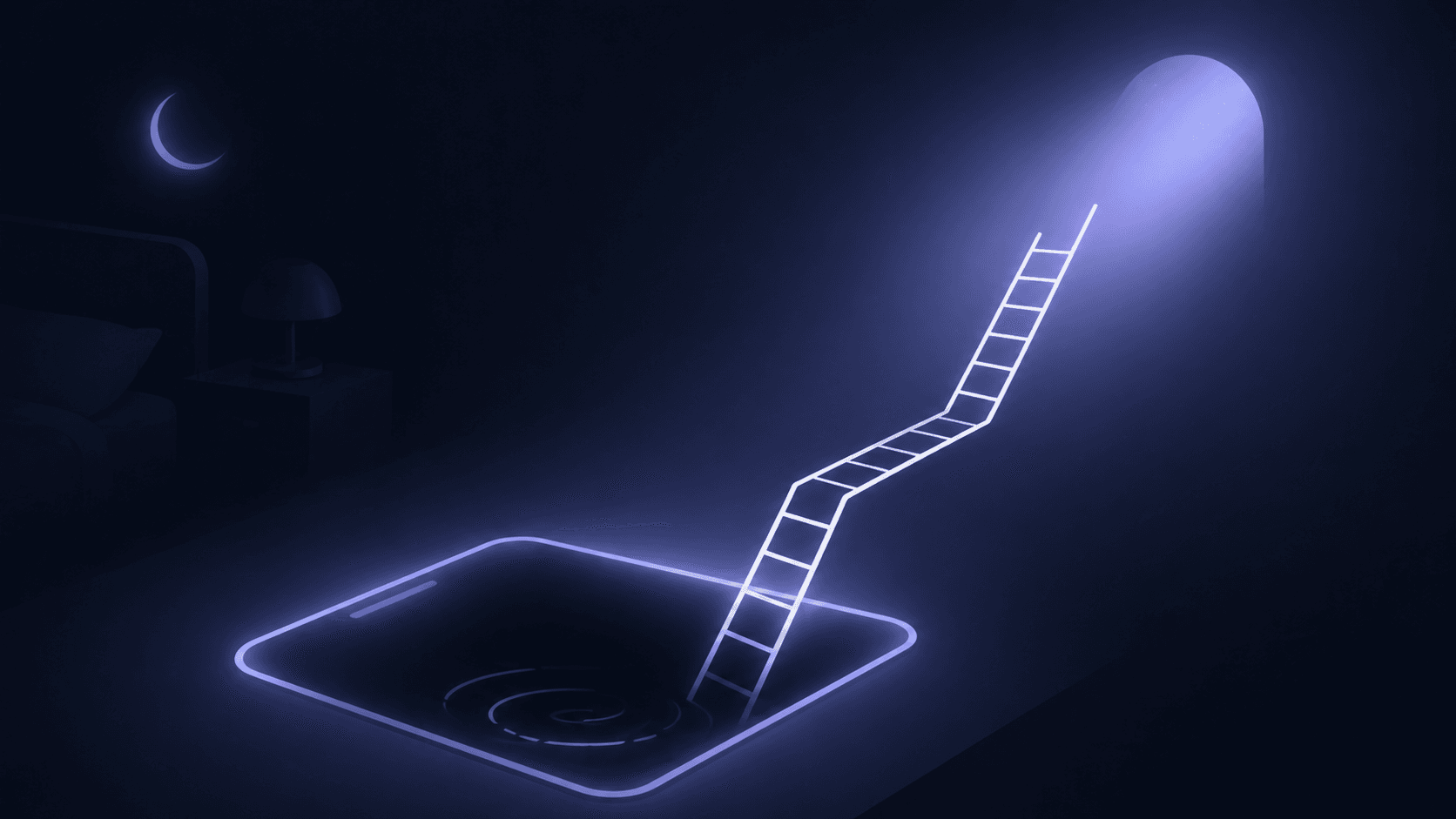
For most people who are trying to cut down or quit porn, the hardest hours are not random.
They cluster around night.
Not just any night, either. There is a specific window — usually somewhere between 10 PM and 2 AM — where most relapses happen. The pattern is so consistent that many users describe their entire problem as a night-time problem. During the day, the urge feels manageable. The plans feel realistic. The decisions feel solid. Then the lights go down, the phone comes into bed, and within an hour the same loop is running again.
This is not a character problem. It is a setup problem.
The reason nights are so hard is that several risk factors stack on top of each other at the exact same time, and most people are trying to fight that stack with the one tool that gets weakest at night: willpower. That approach is almost guaranteed to fail eventually. A better approach starts by understanding what actually happens at night, and then changing the situation rather than the person.
Why nights are the highest-risk window
Late-night relapses are not coincidence. They are the predictable result of four overlapping factors that all peak at the same time.
1. Reduced impulse control from sleep pressure
By late evening, the prefrontal cortex — the part of the brain that handles inhibition, planning, and resisting short-term rewards in favor of long-term goals — is running on a depleted budget. This effect gets worse if sleep has been short on prior nights, even by an hour or two.
A 2017 study published in the Journal of Neuroscience found that sleep deprivation pushes the brain away from goal-directed control and toward habitual control. In plain language: when you are tired, you are more likely to run on autopilot and follow learned patterns, and less likely to pause, reflect, or override an impulse. If your learned night-time pattern is to scroll until you slip, sleep pressure makes that pattern stronger, not weaker.
This is why "I'll just stay up a little longer and then go to sleep" is one of the most dangerous sentences in this whole topic. Every additional tired hour reduces the brain machinery you need to make a different choice.
2. Loneliness and reduced social input
Nights are quieter. Conversations stop. The day's distractions wind down. For people who already live alone, the contrast is even sharper. Even for people who live with others, the bedroom usually means being alone with a phone and nobody watching.
That stillness is not the problem on its own. The problem is what fills it. If porn has become the default way to deal with low-grade emptiness, then quiet evenings reliably activate the same loop. The trigger is not specifically "I want porn" — it is "I do not want to sit in this feeling."
If you have not noticed how often this is the actual starting point, it is worth looking at the broader pattern of triggers that show up before any conscious urge does.
3. The phone in bed
This one is so common it is almost boring to discuss, but it is probably the single most consistent contributor to night-time relapses.
A phone in bed combines four risk factors in one device:
- It removes the friction between you and stimulating content (one tap away).
- It encourages drift — algorithmic feeds nudge you toward more arousing content gradually.
- It is private, in the dark, with nobody watching.
- It is in your hand at exactly the moment your impulse control is weakest.
Most people who relapse at night did not start with the intention to look at porn. They started by checking the time. Or replying to one message. Or scrolling for "just five minutes." The relapse came at the end of a chain that started with a behavior that felt completely innocent.
4. The "I am about to sleep anyway" rationalization
Late at night, the cost of a relapse feels artificially low. There is no day to ruin afterwards. There is no work meeting in two hours. The logic goes: I will just sleep after, and tomorrow I will start fresh.
This reasoning is wrong on two levels. First, the relapse itself disturbs the sleep that would have restored your impulse control for the next day. Second, "starting fresh tomorrow" is rarely how it actually plays out — relapses on consecutive nights are far more common than relapses spread out across a week.
But the rationalization works because it removes the felt urgency of saying no. And once urgency is gone, the loop runs.
Why willpower alone keeps failing here
There is a reason "just resist it" advice does not survive contact with a real night-time situation.
Willpower is not a stable resource. Research on sleep and self-control consistently shows that sleep loss and fatigue impair the prefrontal cortex's ability to override impulsive responses. Even people with strong daytime self-discipline experience measurable drops in inhibitory control after a long day, especially after several nights of insufficient sleep.
This means relying on willpower at night is essentially relying on the version of yourself with the lowest available capacity to make the decision. The version of you that planned the recovery this morning was running on coffee, daylight, and rest. The version of you holding the phone at midnight is not the same person, neurologically speaking.
This is the core mistake of most "quit porn" advice — it assumes a stable self that just needs to be more determined. That self does not exist at midnight.
The realistic approach is the opposite: assume your night-time self will have low capacity, and design the situation so that low capacity is enough. That is what environment design is for.
Environment design: the actual solution
Environment design is the strategy of changing the conditions around the behavior, instead of trying to change the behavior directly under hard conditions. For night-time porn use, this is the single highest-impact intervention available, and it does not depend on motivation.
The principle is simple: increase the friction between you and the relapse, especially during the hours when your impulse control is weakest.
The most effective change: phone out of the bedroom
This one change addresses three of the four risk factors at once.
The phone is the delivery mechanism for the entire loop — content access, algorithmic drift, private viewing, and the hand-to-screen reflex that makes the whole thing feel automatic. Removing it from the bedroom does not require willpower at midnight. It requires one decision in the evening: where the phone sleeps.
Concrete versions of this:
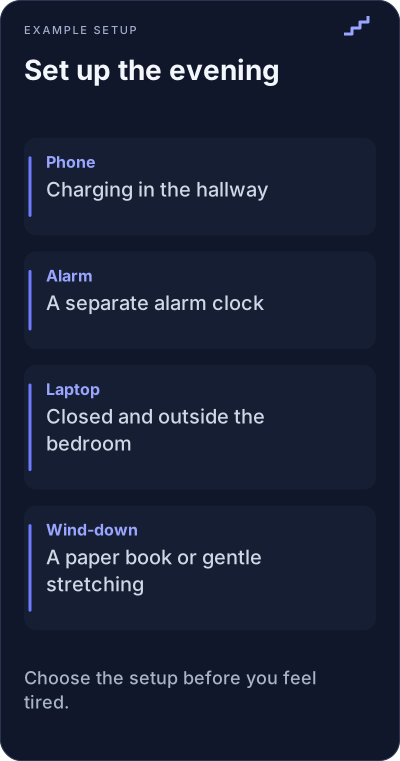
- Charge the phone in the kitchen, hallway, or living room.
- Use a basic alarm clock instead of the phone alarm. Cheap, takes five minutes to buy, eliminates the main excuse.
- If a partner objects to the phone being out of the bedroom for emergencies, set the phone to allow only specific contacts to ring through — most modern phones support this.
The objection people raise to this is always some version of "but I need my phone for X." Almost every X has a workable alternative. The real reason people resist this change is not practical. It is that the phone in bed is comfortable, familiar, and provides the very behavior that the recovery is trying to interrupt.
Secondary environment changes
Beyond the phone, a few other changes compound the effect:
- Laptop closed and out of the bedroom — same principle, larger device.
- Bedroom lights off earlier — darker rooms make scrolling feel less appealing and accelerate sleep onset.
- Browser blockers on the laptop and phone — not as a primary defense, but as additional friction that makes "just checking" take an extra step. Tools like Cold Turkey, Freedom, or built-in iOS Screen Time content restrictions are reasonable starting points.
- Routine wind-down activity that does not involve a screen — reading a paper book, stretching, journaling, anything that signals "the day is ending."
None of these are heroic. Each one is a small reduction in friction in the wrong direction, and a small increase in friction in the right one. Stacked together, they change the default behavior at the exact hours that matter most.
Why gradual reduction often works better at night than cold turkey
Most people in this situation default to a cold-turkey commitment. "Starting tonight, no porn ever again." It feels strong. It feels decisive.
It also fails, predictably, on a specific kind of night: the one where energy is low, sleep is short, the phone is in bed, and the rationalization shows up. After the first cold-turkey relapse, shame kicks in, the streak collapses, and the loop intensifies for several days.
A gradual approach handles night-time risk better for a specific reason: it reduces the catastrophic weight of any single slip. When the goal is "complete reduction over time" with explicit cycles instead of an unbroken chain, a single late-night relapse does not destroy the entire plan. It is a setback inside a longer pattern, not a failure of the whole project.
This is the structure that Reset Ladder is built around. Instead of a single binary streak that gets reset to zero on any slip, the methodology uses a ladder of strictness levels and explicit reset cycles. The goal is to reduce frequency over time, not to demand perfection on the worst possible night. For night-time relapses specifically, this matters because nights are exactly where binary streak systems collapse most often, and where the all-or-nothing thinking that follows a slip causes the most secondary damage.
If a single late-night relapse is causing the rest of the week to fall apart, the streak system itself is part of the problem. A clearer reframe: the spiral after a relapse is usually more damaging than the relapse itself, and a gradual structure is designed to interrupt that spiral instead of amplifying it.
A practical night-time protocol
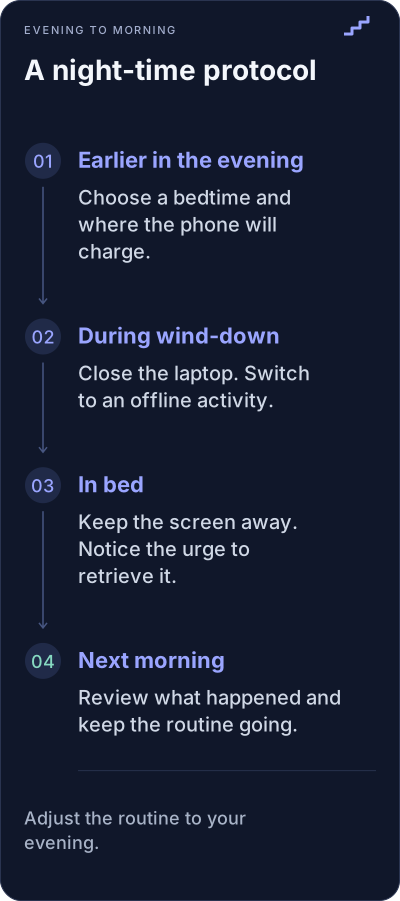
For anyone wanting something concrete to try this week, here is a starting protocol that addresses the four risk factors directly. Adjust to what actually fits the situation.
Earlier in the evening (8–9 PM):
- Decide where the phone sleeps tonight. Put it there before getting tired.
- Decide a "lights out" target time and work backwards from it.
Wind-down period (one hour before bed):
- Phone is no longer in hand.
- Laptop is closed.
- Lights are dimmer.
- Activity is non-stimulating: book, stretching, shower, conversation.
In bed:
- No screen. If sleep is hard, a paper book is the safest option.
- If the urge to retrieve the phone shows up, name it: "this is the night-time pattern, not a real need."
- If a slip happens anyway, do not stay up trying to "make up for it." Sleep is the higher-order recovery action.
Next morning:
- Do not reset everything emotionally. The protocol is the protocol whether last night went well or not. Consistency of the structure matters more than any single night's outcome.
This is not a complete recovery plan. It is a focused intervention on the highest-risk hours. For most people, fixing the night-time window has the largest single impact on overall frequency.
What progress actually looks like here
People often expect that the right approach should produce immediate, dramatic improvement. For night-time relapses, that is not usually how it goes.
What progress usually looks like:
- The first week with the phone out of the bedroom feels uncomfortable. That is not failure — it is the absence of a familiar coping mechanism.
- Frequency drops first, before duration of cleaner stretches. The loop happens less often before any individual stretch gets long.
- The "I already messed up" thoughts start losing their power as the gradual structure makes them feel less true.
- Sleep quality improves, which over a few weeks compounds back into better impulse control during waking hours.
If you are looking for the same insight from a different angle, the deeper version of this — why willpower keeps failing in general for porn recovery, and what to build instead — covers the underlying logic that this night-time protocol is one application of.
FAQ
Why do I always relapse at night even when I'm fine all day?
Late evening combines several risk factors that day-time situations usually do not: reduced impulse control from accumulated tiredness, social isolation, the phone in bed, and the rationalization that "I'm about to sleep anyway." These compound to make night the highest-risk window for most people. The answer is rarely more daytime willpower — it is changing the night-time setup so that low willpower is enough.
Does keeping the phone out of the bedroom really work?
For most people, this is the single highest-impact change available. It removes the main delivery mechanism for the night-time loop and does not require willpower at the moment of temptation. The hard part is committing to the change consistently for two to three weeks before judging it. The first few nights feel uncomfortable, which is normal — the discomfort is the absence of a familiar coping pattern, not evidence the approach is wrong.
What if I need my phone in the bedroom for emergencies?
Most modern phones allow selected contacts to ring through even in Do Not Disturb or focus modes, so emergency calls still come through from the next room. A basic standalone alarm clock costs little and removes the most common practical objection. The phone-in-bed habit is rarely about genuine emergency access — it is about familiarity and convenience, which are exactly the reasons it is so dangerous late at night.
Is gradual reduction really better than just quitting completely?
For night-time relapses specifically, gradual reduction tends to be more sustainable than cold turkey for one main reason: it reduces the destructive weight of any single slip. Cold-turkey systems treat every relapse as a complete failure, which often triggers a multi-day spiral after a single bad night. A gradual approach with explicit cycles absorbs occasional slips without collapsing the entire plan. This is especially relevant at night, when the worst-case neurological conditions for self-control align with the highest temptation density.
If this approach makes sense, Reset Ladder is built around the principles in this post — gradual cycles instead of all-or-nothing streaks, with explicit recovery built in for the kind of night-time slips that destroy traditional streak systems. It is available on the App Store.

Available on the App Store.
A structured plan to reduce or quit porn —
without shame, surveillance, or religion. Start your first cycle today.