No Nut November: What It Gets Right, Where It Backfires, and a Calmer Way to Do It
No Nut November is a meme, a challenge and, for some, a real attempt to quit porn. What it gets right, where it backfires, and how to make it last.

Every November, a joke turns into a challenge: go the whole month without porn and masturbation. For some people it stays a meme. For others it's the first serious attempt to change a habit they've been uneasy about for a long time.
If you're in the second group, it's worth knowing what the challenge does well, where it reliably goes wrong, and how to keep the useful part going after the month ends.
What the challenge gets right
It gives you a start date. A lot of people want to change something "at some point." A shared, public start date removes the endless "maybe next week."
It's social. Knowing thousands of other people are attempting the same thing makes it feel less strange and less lonely. Isolation makes habits harder to change; even a loose sense of company helps.
It's time-limited. Thirty days feels doable in a way that "forever" doesn't. That makes it easier to start.
Where it tends to backfire
It's all-or-nothing. The rules are binary: you either made it or you "failed." One slip on day 9 and many people decide the month is ruined, and the next few days turn into a binge. Psychologists sometimes call this the "what-the-hell effect": the rule is already broken, so why hold back now? The slip itself is rarely the real damage. The story after it is.
It treats the habit like a test of willpower. The challenge rarely asks why the habit happens. Without knowing your triggers (late nights, boredom, stress, the phone in bed) you're relying on raw willpower at exactly the hours when willpower is lowest. If you want to see your own pattern, porn triggers is a good place to start.
It bundles two different goals. The challenge usually covers both porn and masturbation. Those are separate goals, and plenty of people only want to change the first one. Pick the goal that actually matters to you; you don't have to adopt someone else's.
It has a cliff at the end. December 1st is the most predictable relapse day of the year. If nothing about your evenings changed, the deadline was the only thing holding the line. When it passes, everything rushes back in.
A calmer way to do November
You can keep the start date and the momentum, and drop the parts that make people quit.
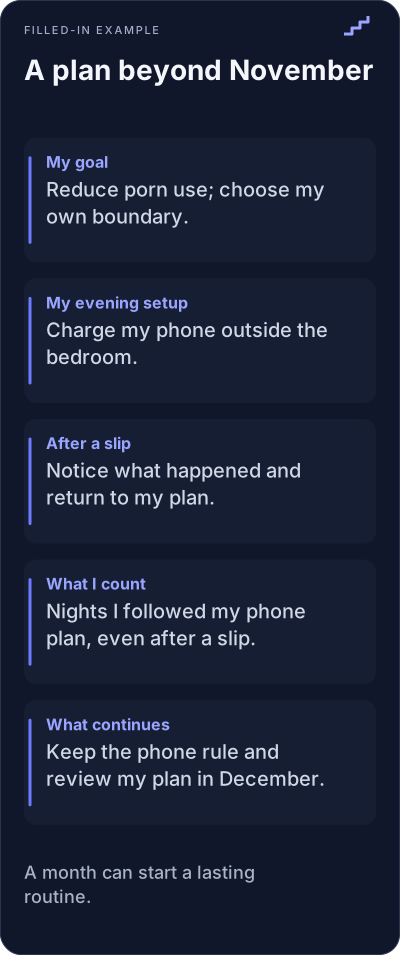
- Choose your own goal. Porn only, both, or simply "less than October." Write it down in one sentence.
- Plan for the two riskiest hours. For most people that's late evening and right before sleep. Decide now where the phone charges at night.
- Decide in advance what a slip means. Not "I failed November," but "the night ended badly, tomorrow is a normal day." Having that sentence ready before day 9 makes a real difference. If it happens, what to do after a relapse walks through the first hour.
- Count something other than an unbroken streak. Good days this month, urges you rode out, nights the phone stayed outside the bedroom. Numbers that only go up don't punish you for one bad night.
- Plan December now. Keep two or three rules from November going into December instead of treating November 30 as a finish line.
If you're using it to quit for good
A month-long challenge can be a good first step, but most lasting change looks gradual rather than heroic: fewer slips over time, slips further apart, an easier time getting back on track. If cold-turkey challenges keep ending the same way for you, it might be worth reading about gradual reduction vs cold turkey.
Reset Ladder is built around that gradual approach: a private plan of small steps, where a slip moves you one step back instead of resetting everything to zero. No account, and nothing leaves your phone.
Whatever you choose, the goal isn't to survive thirty days. It's to come out of November with a plan you can keep using in December.
This article is general information, not medical or psychological advice. If this behavior is causing you significant distress, consider speaking with a licensed mental health professional.

Available on the App Store.
A structured plan to reduce or quit porn —
without shame, surveillance, or religion. Start your first cycle today.